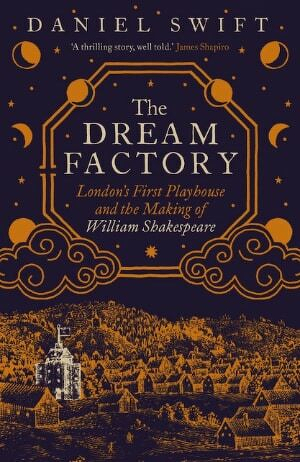
A while back, I went to a fascinating talk on The Theatre – the original Elizabethan theatre where Shakespeare learned his trade when he first came to London. It was given by the author Daniel Swift, drawing on his book, The Dream Factory: London’s First Playhouse and the Making of William Shakespeare.
Having just finished the book, what struck me was the idea of Shakespeare as an apprentice, as someone who learned his trade. There are those, still, who argue that William Shakespeare could not have been ’Shakespeare’, that the grammar-school boy from Stratford could not have written the plays. They must have been written by someone else. (Generally someone more upper class, more aristocratic, generally posher – it’s essentially an argument driven by elitism.)
This theory has been pretty much completely shot down by scholars such as James Shapiro, but reading The Dream Factory shows how it also ignores the evidence of his peers and the working practices of the time. There is plenty of evidence for Shakespeare as a writer – working with other writers, and serving as an apprentice.
Because here’s the truth: Shakespeare learned his trade.
He learned it through collaborating with other – more successful and more highly regarded – playwrights. He learned it through adapting, even copying, other peoples’ work. He learned it through acting on stage and he learned it through the discipline of having to sell tickets.
Yes, he was a genius, but he also learned his trade.
Which is really the point. If you think of genius as something which just happens, without any need for effort, or training or craftsmanship, then you don’t really understand genius.
The idea of the writer as an artist, even as a professional, is quite recent. Before then, writers were workers. Shakespeare was a play-wright, a term which dates from 1605. According to the OED, a ‘wright’ is ‘An artificer or handicraftsman; esp. a constructive workman’. He was a makers or craftsman, on a par with the ship-wright or the wheel-wright.
On the rare occasions I teach about writing, I always start with structure, with how the piece is put together. Because, before you can do all the stylish stuff, you have to learn the basics.
You have to study your craft and serve your time. You have to apprentice yourself.
After all, if it was good enough for Shakespeare…